Wednesday, January 11, 2012

3.1 Exponential Functions and Their Graphs

Exponential Functions
Section 3.1 discusses exponential functions and their graphs.


Rules for Exponents

Polynomial and Exponential Functions Differ
In polynomial functions, a variable is raised to a term, while in an exponential functions, a term is raised to a variable.

Here a is the base and n is the exponent:


When two of the same bases are multiplied, the exponents are added together:


When two of the same bases are divided, the exponents are subtracted:


When a base and its exponent are raised by another power, the exponents are multiplied:


When the exponent is negative, the result if the reciprocal of the base and positive exponent:


Anything raised to the first power is equal to itself:


Anything raised to the zero power is one:


Exponential Functions and Their Graphs
The basic exponential function:


Here a is the base and x is the exponent. a is multiplied by itself x number of times.


Graphs of Exponential Functions:


The basic exponential function graph for the above exponential function (where a is the base and x is the exponent).


The y-intercept for all unmanipulated exponential functions is y=1.


The horizontal asymptote is at .
The domain is .
The range is .

Manipulating Exponential Functions:


describes the possible ways exponential functions and consequently their graphs can be manipulated.


When a is changed:


-The graph is vertically stretched by a factor of a if a>1.


-The graph is vertically compressed by a factor of a if a<1.

-If a is negative, the graph is reflected in the x-axis.


When b (the base) is changed:


-The y-intercept is unchanged


-The graph increases of decreases by a larger factor depending on whether b is less than or greater than 1, respectively.


When c exists:


-The graph moves right a factor of c when x-c.


-The graph moves left a factor of c when x+c.


When d exists:


-The graph moves up a factor of d when d is added.


-The graph moves down a factor of d when d is subtracted.


Examples:


Vertical compression.


Increased growth factor, shifted up 6 units (note change in y-intercept).


Compound Interest


When finding the compound interest, use:


A=Present value


P= Principal (initial value)


r=Annual interest rate (APR)


n= Number of compounding periods per year


t=Time in years


Example:


A total of $14,000 is invested at an annual interest rate of 8%. Find the balance after 4 years if it is compounded monthly:


Substitute 14,000 for P.


Substitute .08 for r (remember to convert 8% to decimal form).


Subsitute 12 for n (there are 12 months in 1 year).


Sustitute 4 for t.


Solve: $19,259.33


For continuously compounded interest, use:


e is the natural base, and is a button found on your calculator.


Example:


Using the same figures from the first example, the answer is: $19,279.79


Thursday, January 5, 2012

6.2 Law of Cosines

You can solve an oblique triangle if you have all three sides (SSS) or two sides with their included angle (SAS) using the law of cosines.


Law of Cosines


Proof of Law of Cosines


(page two)


The Law of Cosines can also be used to establish the following formula for the area of a triangle. This formula is called Heron's Area Formula.


Given any triangle with sides of lengths a, b, and c, the area of the triangle is:


Tuesday, January 3, 2012

Section 6.1 Law of Sines

The Law of Sines only find unknowns in oblique triangles. Oblique triangles are triangles that have no right angles.
The Law of Sines can be derived from an oblique triangle, by drawing an altitude from any side(h).
Using sine trigonometry you can break the triangle into two parts.
1.
2.
Now,it is possible to substitute for h. In order to have a trigonometry h needs to be eliminated.
Divide each side by c
Since you can draw an altitude from any of the sides all of the proportions are equal.
Example:
To find the area one can derive the equation from an oblique triangle with an altitude.
Since the altitude can be drawn from any side, the Area formula can change as long as it uses two sides and the included angle. Here are some other forms:

Wednesday, December 14, 2011

Chapter 5.5

  • Power-Reducing Formulas
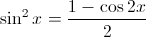
*The following power-reducing formulas can be derived from the double-angle formulas.


  • Half-Angle Formulas
*You can derive the half-angle formulas from the power-reducing formulas by replacing x with x/2.


  • Product-to-Sum Formulas
*each of the following product-to-sum formulas can be verified using the sum and difference formulas.


  • Sum-to-Product Formulas
*Sometimes it is useful to reverse the procedure and write a sum of trigonometric functions as a product. This can be done with the following sum-to-product formulas.

Mr. Wilhelm-
I was unable to comment in the comment box, so I have posted my response:

I find simplifying and solving multiple-angle equations to be challenging. For example, knowing where to start and how to continue on when solving equations such as cos5x-7cos2x=8 is difficult as these problems may become very long, and many times lead to dead ends. In addition, several different identities must be substituted in for other terms in order to solve these problems. There are often several identities to choice from, and some identities may equal more than one thing, as does cos2x. Deciding which identity to substitute in is often difficult.

Daynna Myers

Chapter 5 Muddiest Points

What about Chapter 5 is most confusing for you?

(Answer this question by commenting on this post.)

Monday, December 12, 2011

Section 5.5 (part 1, pages 411-413): Double-Angle Formulas

SINE
COSINE
TANGENT

*These formulas are the most commonly used multiple-angle formulas. Like other trigonometric identities, they are used to rewrite trigonometric functions in more convenient forms.

Proof of the SINE formula:

Proof of the COSINE formula:

Proof of the TANGENT formula:

*Compared to others, the proofs for the double-angle formulas are simple. Their basis are the Sum & Difference Formulas for sine, cosine, and tangent (Section 5.4, page 404).

Practice Problem (page 411): Solving a Double-Angle Equation

Find all solutions of 2cosx + sin2x = 0

1. 2cosx + 2sinxcosx = 0 (substitute the SINE double-angle formula for sin2x)

2. 2cosx(1 + sinx) = 0 (factor out a 2cosx)

3. 2cosx = 0, 1 + sinx = 0 (set both factors equal to 0)

4. cosx = 0, sin = -1 (simplify both factors)

5. x = , x = (use prior knowledge of the unit circle to find all solutions for x on the interval )

6. x = (eliminate duplicate solutions)

*Depending on the period of the equation, there may be additional answers.